If you follow skincare at all, you've heard the phrase "skin barrier" more times in the past year than in the previous decade combined. Skincare brands have reorganized their entire product lines around it. It has become the lens through which the industry now interprets everything, cleansers, moisturizers, actives, routines.
And for good reason. The skin barrier is genuinely foundational. It is not a trend. It is the structural basis of how healthy skin functions, and when it is compromised, nearly every other skin concern gets harder to manage.
What has not made it into the mainstream skin barrier conversation is what happens to it every time you get in a pool. Swimmers have been unknowingly disrupting their skin barrier for years. Most don't register the damage until it's showing up as persistent dryness, redness, or that tight, stripped-down feeling that follows every session. By that point, the disruption has already occurred.
Here is what is actually happening, and what you can do about it.
What the skin barrier actually is
The skin barrier is not a single layer. It is the outermost section of the skin, the stratum corneum, composed of flattened, dead skin cells held together by a dense matrix of natural lipids. Those lipids include ceramides, fatty acids, and cholesterol. Their function is dual and simultaneous: they hold moisture inside the skin, and they hold environmental threats, irritants, pathogens, chemical stressors, outside it.
The simplest way to understand it is as a brick wall. The skin cells are the bricks. The lipid matrix is the mortar. When the mortar is intact, the structure holds. When it degrades, the wall loses integrity in both directions, moisture escapes outward more readily, and external threats penetrate inward more easily.
A healthy skin barrier retains moisture efficiently, responds calmly to environmental exposure, and recovers quickly from stress. A compromised skin barrier does the opposite on all three counts.
Most of the current conversation about skin barrier protection focuses on what cleansers, exfoliants, and routine choices do to it. That conversation is valid. But swimmers have an additional and significant source of disruption that is rarely addressed in the same breath: the pool itself.
What chlorine does to your skin barrier
Chlorine is in pool water because it works. It kills the bacteria and pathogens that would otherwise make shared water genuinely hazardous. The presence of chlorine in a swimming pool is not a problem, it is the reason public pools are safe to swim in.
The issue is that chlorine does not distinguish between the pathogens it is meant to neutralize and the natural lipids that make up your skin barrier. When chlorinated water contacts skin, several processes occur at once.
It strips the lipid layer
Chlorine is a chemical oxidizer. It breaks down organic compounds, that is the mechanism by which it eliminates bacteria. Your skin's lipid matrix is also an organic compound. Repeated or prolonged contact with chlorinated water gradually degrades that lipid layer, weakening the structural mortar of the skin barrier and reducing its capacity to retain moisture and resist external irritants.
It raises your skin's pH
Healthy skin is slightly acidic, typically sitting between 4.5 and 5.5 on the pH scale. This mild acidity is functional, not incidental, it supports the enzymes that maintain the lipid layer and contributes to the skin's natural resistance to microbial growth. Pool water is maintained at a pH of 7.2 to 7.8. That is meaningfully more alkaline than healthy skin. Repeated exposure incrementally shifts the skin's pH in the wrong direction, progressively diminishing the barrier's ability to do its job.
It causes transepidermal water loss
When the lipid matrix is disrupted, moisture escapes the skin at a higher rate than normal. This is called transepidermal water loss, or TEWL. Most swimmers recognize it immediately: the tight, parched sensation that hits within minutes of leaving the pool. That sensation is the skin signaling that it is losing water faster than it should.
This is not anecdotal. Research published in the International Journal of Environmental Research and Public Health measured TEWL in elite swimmers before and after a two-hour pool training session. Swimmers showed significantly elevated TEWL on the forearm, hand dorsum, and antecubital flexure both immediately after the session and 30 minutes after leaving the water. Non-swimming athletes in the same study showed no comparable pattern. It is worth noting that the study's authors explicitly state their findings apply to elite swimmers and cannot be generalized to recreational swimmers, the research establishes the physiological mechanism, but the degree of TEWL increase in casual swimmers may differ. The researchers also noted that prior studies have found a dose-response association between exposure duration to chlorinated pools and incidence of contact dermatitis.
The effects don't stop when you get out
Rinsing off after a swim removes much of the surface exposure, but the disruption to the lipid layer and pH that occurred during the session does not reverse immediately. Chlorination byproducts can also remain on the skin after swimming, and the dryness and tightness many swimmers experience tends to feel more pronounced as the skin dries, which is consistent with the ongoing process of moisture escaping through a disrupted barrier. Rinsing off promptly and moisturizing afterward are the most practical ways to slow that process.
None of this is alarming in the context of an occasional swim. A healthy skin barrier is resilient and recovers. The concern with cumulative exposure, the recreational swimmer in the pool twice a week through an entire summer, the competitive swimmer training five days a week, the child in swim lessons twice a week for three months, is that with repeated disruption and no protective routine, the lipid layer may not fully recover between sessions. Over a full season, those effects can accumulate.
Protect your skin barrier before it shows signs of damage.
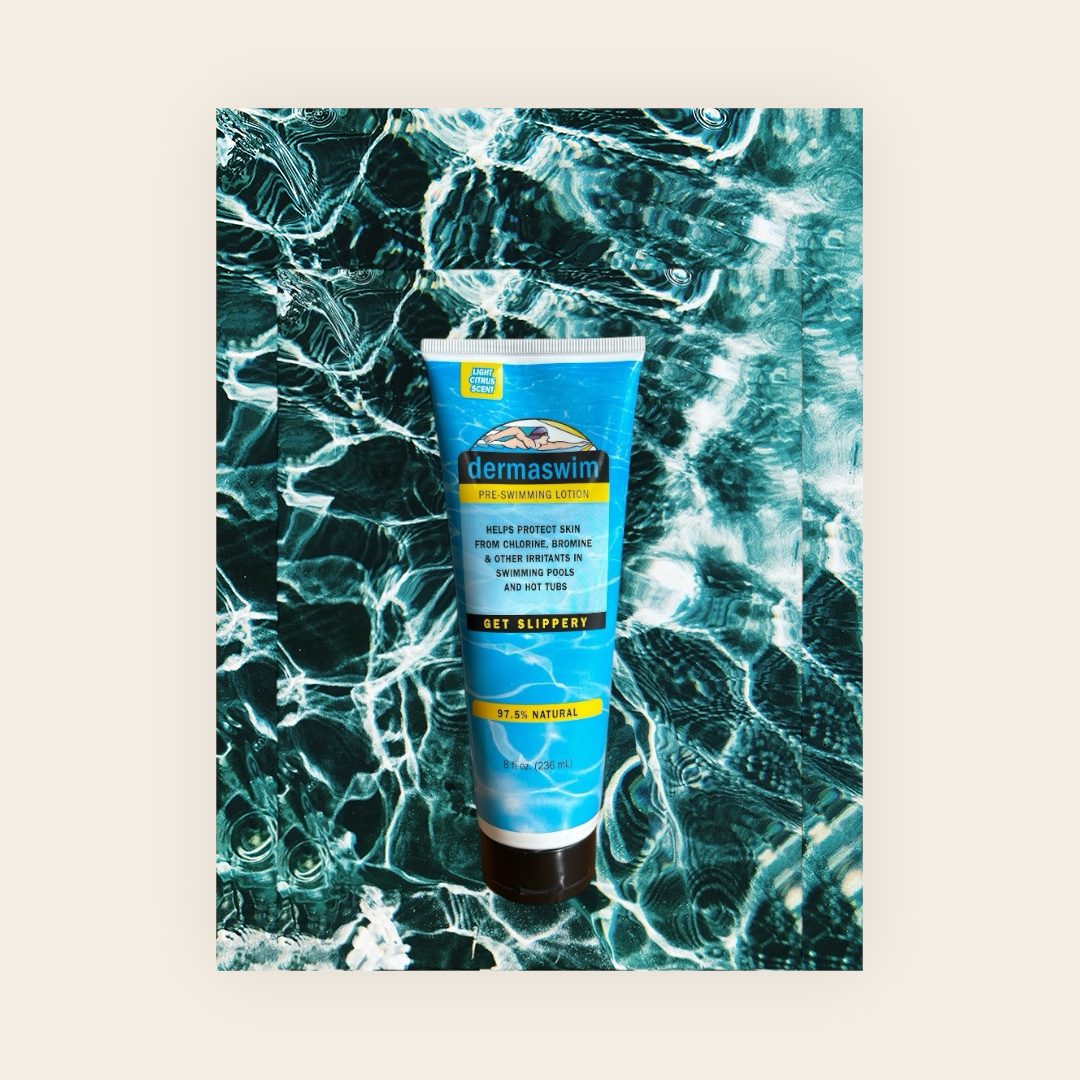
DermaSwim pre-swim lotion creates a physical barrier on the skin's surface before you enter the pool, formulated with beeswax, coconut oil, and aloe vera to help reduce chlorine exposure during every swim.
Why preventing barrier disruption is more effective than repairing it
Once the lipid layer is degraded, restoring it takes time. The skin does regenerate its lipid matrix, but that regeneration operates on the skin's own timeline, not yours. Applying a ceramide-rich moisturizer after swimming supports that recovery process and is worth doing. But post-swim moisturizer is responding to disruption that has already occurred.
The more effective approach is reducing how much disruption happens in the first place.
This is where pre-swim barrier protection fits into the skin barrier conversation in a way that most skincare content has not yet addressed. Applying a barrier product before you enter the pool creates an additional physical layer between your skin and the chlorinated water, supplementing the skin's own barrier while it is under chemical pressure.
The goal is not to make the skin impermeable. It is to reduce the degree of lipid stripping and pH disruption that accumulates across each session, so the skin barrier has less ground to recover each time.
What to look for in a pre-swim barrier product
Not every lotion provides meaningful protection in chlorinated water. Water-soluble products disperse almost immediately in the pool and leave little behind. An effective pre-swim barrier product needs to be formulated around wax-based or oil-based ingredients, compounds that adhere to the skin's surface and resist the wash-off that standard lotions cannot.
DermaSwim pre-swim lotion is built around beeswax, coconut oil, and aloe vera, ingredients chosen specifically for their ability to form a durable, protective layer on the skin's surface during pool exposure. The formula is 97.5% natural and paraben-free.*
Apply DermaSwim before entering the pool. For outdoor swimmers, apply DermaSwim first, then apply water-resistant sunscreen on top. The two products address different threats, chlorine and UV respectively, and neither substitutes for the other.
It is important to be precise about what DermaSwim does and does not do. It helps protect the skin's surface from chlorine exposure during swimming. It is not a medical product, it does not treat any skin condition, and it does not repair a compromised skin barrier. If you have a diagnosed skin condition, consult your healthcare provider before adding any new product to your routine.
A complete pre- and post-swim routine for skin barrier health
Pre-swim protection is most effective as part of a consistent routine that addresses each stage of a swim session. Here is what each step does and why the sequence matters.
Before you swim
Rinse your skin briefly with fresh water before entering the pool. Dry skin is more absorbent than skin that is already saturated with clean water, a quick rinse pre-saturates the skin and limits how much chlorinated water it can take in during the session. Then apply DermaSwim before getting in.
DermaSwim is available on Amazon, keep a tube in your swim bag so it's there every time without thinking about it.
After you swim
Rinse thoroughly with fresh water as soon as possible after leaving the pool. The longer chlorine residue remains on the skin, the longer its oxidative process continues. Shower with a gentle, pH-balanced body wash rather than a harsh soap, which compounds the pH disruption the pool already caused. Follow with a fragrance-free moisturizer containing ceramides or other barrier-supporting lipids. This does not undo the session's disruption immediately, but it gives the skin the materials it needs to begin rebuilding.
Across the full season
The cumulative dimension is what most swimmers underestimate. A single unprotected swim is unlikely to produce visible lasting damage for most people. A full summer of unprotected swimming multiple times per week, with no recovery routine between sessions, produces a very different result by mid-season. The time to build these habits is at the start of the season, not after the dryness and irritation have already set in. Prevention is always more efficient than management.
Common questions about chlorine and the skin barrier
What does chlorine do to the skin barrier?
Chlorine strips the natural lipid layer from the stratum corneum, raises the skin's pH away from its healthy acidic range, and causes increased transepidermal water loss. The combined effect is dryness, tightness, and heightened skin sensitivity that worsens with repeated unprotected exposure.
What is transepidermal water loss and does swimming cause it?
Transepidermal water loss (TEWL) is the rate at which moisture escapes through the skin barrier. Research published in the International Journal of Environmental Research and Public Health found that elite swimmers showed significantly elevated TEWL after a two-hour pool session compared to non-swimming athletes, with water loss remaining measurably higher 30 minutes after leaving the pool. The study authors note these findings apply specifically to elite swimmers and may not generalize to recreational swimmers, though the underlying mechanism, chlorine disruption of the lipid barrier, applies broadly.
Does chlorine permanently damage the skin barrier?
Occasional swimming is unlikely to produce permanent damage in most people. The concern is cumulative: regular swimming without protection across an entire season can prevent the lipid layer from fully recovering between sessions, with effects that compound over time. A consistent pre- and post-swim routine reduces this significantly.
What pH is pool water and why does it matter for skin?
Pool water is maintained at a pH of 7.2 to 7.8. Healthy skin sits between 4.5 and 5.5. Repeated exposure to the more alkaline pool environment incrementally shifts the skin's pH away from its optimal range, weakening the barrier's ability to retain moisture and resist external irritants.
How does a pre-swim lotion protect the skin barrier?
A pre-swim lotion built around wax-based or oil-based ingredients creates a physical layer on the skin's surface that helps reduce direct contact between chlorinated water and the skin's lipid layer. It reduces the degree of disruption per session, it does not eliminate it entirely, giving the skin barrier less recovery work after each swim.
The bottom line
The skin barrier conversation that has taken over skincare in 2026 is well-founded. And for swimmers, it carries a dimension that the broader conversation has not caught up to: every pool session is a direct chemical challenge to the barrier's structural integrity.
Chlorine strips lipids, raises skin pH, and causes measurable moisture loss with each swim. The effects accumulate. But they are substantially preventable with the right approach, applied before you get in the water. The skin barrier is your skin's primary defense system. Protecting it consistently, at the beginning of every session, before it shows signs of wear, is how you keep it functioning properly through an entire swim season.
Start protecting your skin barrier before the season starts.
DermaSwim is 97.5% natural, paraben-free, and formulated specifically for pre-swim use. Apply it before every session, pool, hot tub, or open water.
*97.5% natural based on weight/volume of natural-origin ingredients.
This post is for informational purposes only and does not constitute medical advice. If you have a skin condition or skin health concerns, consult a qualified healthcare provider.